What makes this exercise particularly effective?
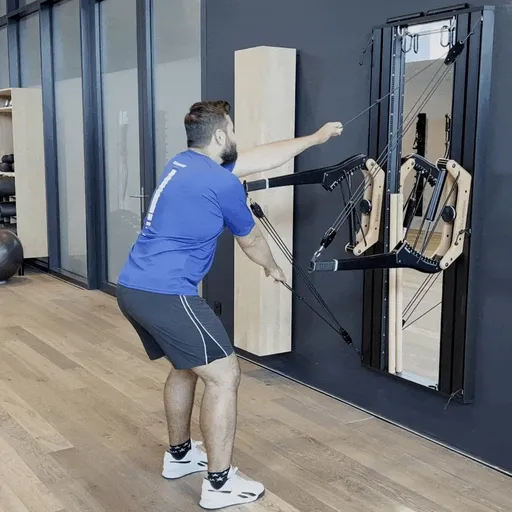
The Bent-over Reverse Fly with Cable Machine (Cable Reverse Fly) specifically targets the rear shoulders (posterior deltoid), as well as the rhomboids and middle trapezius. On the EISENHORN DS, the cable ensures constant tension throughout the entire movement, preventing the typical “dead point” where the weight might otherwise roll out.
The bent-over position isolates the rear shoulder, as the focus is on abduction (lateral lifting outward), while other pulling or pushing muscles are less engaged. Additionally, the movement is relatively short and controlled, which greatly reduces the risk of improper execution or swinging.
What effect does the exercise achieve?
Targeted rear shoulder strengthening: The posterior deltoid is specifically activated, a muscle often neglected in shoulder training.
Support of upper back muscles: The rhomboids, middle trapezius, and rotator cuff are involved, contributing to better shoulder alignment.
Posture improvement & prevention: Regular training of these muscles can counteract a rounded back and stabilize shoulder positioning.
Constant muscle tension: The cable pulley ensures tension is maintained throughout the entire range of motion, including both the upper and lower portions of the movement.
Fine-tuning & balancing: Asymmetrical weaknesses can be addressed more effectively because the range of motion remains controlled for each side.
How does this exercise fit into the Big 5 concept?
The Big 5 include the fundamental exercises: squat, deadlift, bench press, pull-up or lat pulldown, and shoulder press. Even though the Bent-over Cable Reverse Fly is not part of the classical Big 5, it can be a meaningful addition:
Counterbalance to pressing movements: While exercises like bench press and shoulder press primarily target the front shoulder and chest, this exercise provides a targeted opposing movement, balancing the muscles.
Strengthening stabilizers: A strong rear shoulder and upper back improve stability during basic exercises such as deadlifts or bench presses, helping prevent injuries.
Fine-tuning & detail work: In a serious strength program, large multi-joint exercises alone are often insufficient—reverse flys offer a valuable isolation stimulus.
Overall function: Well-developed rear shoulder and upper back muscles enhance power transmission and posture, which in the long term also improves performance in the Big 5.
:format(webp))
)
)
)
)
)
:format(webp) "EISENHORN S Black Edition")
 "EISENHORN S Black Edition")